
Tree Protection Plans for Development Sites
AQF Level 5 consulting arborist · North Shore, Northern Beaches and greater Sydney
Where council requires trees on a development site to be protected, you may need a Tree Protection Plan (TPP) or a Tree Protection Specification (TPS).
What a Tree Protection Plan includes
A Tree Protection Plan sets out how retained trees on site will be protected. This includes:
- the Notional Root Zone (NRZ) and Structural Root Zone (SRZ) of every tree being retained
- tree protection recommendations, such as protective fencing, trunk and branch protection, ground protection and any root-sensitive work methods
- trees to be removed or transplanted, where other drawings don’t already show them
Trees growing close together, with overlapping root zones, can be grouped into one protection zone. The TPP becomes part of the development plans, and the protection zones and devices should also appear on the demolition, earthworks, construction and landscape plans.
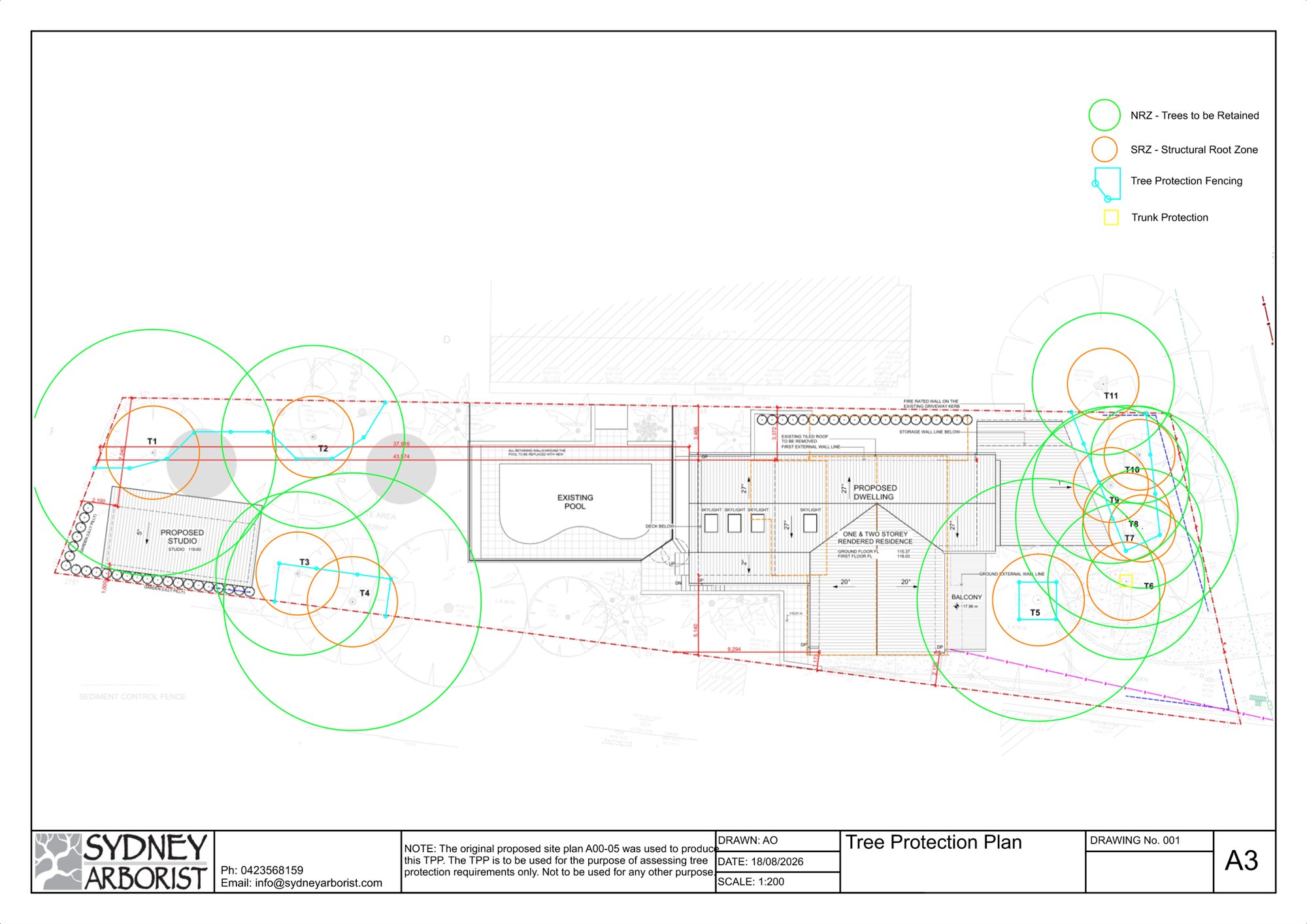
Example Tree Protection Plan. Site details removed.
The Tree Protection Specification
The TPS is the written document that goes with the plan. It:
- sets out, step by step, how the trees will be protected and managed throughout the development
- states what is not allowed where details are still missing, for example no trenching inside a root zone until a services plan exists
- identifies the critical stages, or hold points, where the project arborist inspects
The current versions of the TPP and TPS belong in the construction documentation, so everyone on site works from the same plan.
When the plans change
If the design changes through the consent process, or new work is added near the trees, the TPP and TPS are reviewed and updated to match. Each issue is version-controlled, so the builder, certifier and council always know which one is current.
When you need one
- with a DA, where trees are being retained near the proposed works
- when a condition of consent requires tree protection measures
- before demolition or construction starts on a site with protected trees
How it fits with your AIA
The Arboricultural Impact Assessment works out which trees can be retained and how the design affects them. The TPP and TPS turn that into instructions for the site. During construction, a Project Arborist checks the protection is installed and maintained, and signs off at each hold point.
Frequently asked questions
Is a Tree Protection Plan the same as an AIA?
No. The AIA assesses how the development affects the trees. The TPP and TPS set out how the trees being kept will be protected on site. Councils usually want both.
Who prepares the TPP and TPS?
Under AS 4970 they are prepared by the project arborist, and kept up to date as the project changes.
Who installs the tree protection?
The builder installs it to the plan. The project arborist then inspects it, and certifies it before work starts.
Can work happen inside the NRZ?
Only where it has been assessed and approved. The specification sets out any limits, and the work is carried out with root-sensitive methods.
Get a quote for a Tree Protection Plan. Call Antony on 0423 568 159 or send your plans.